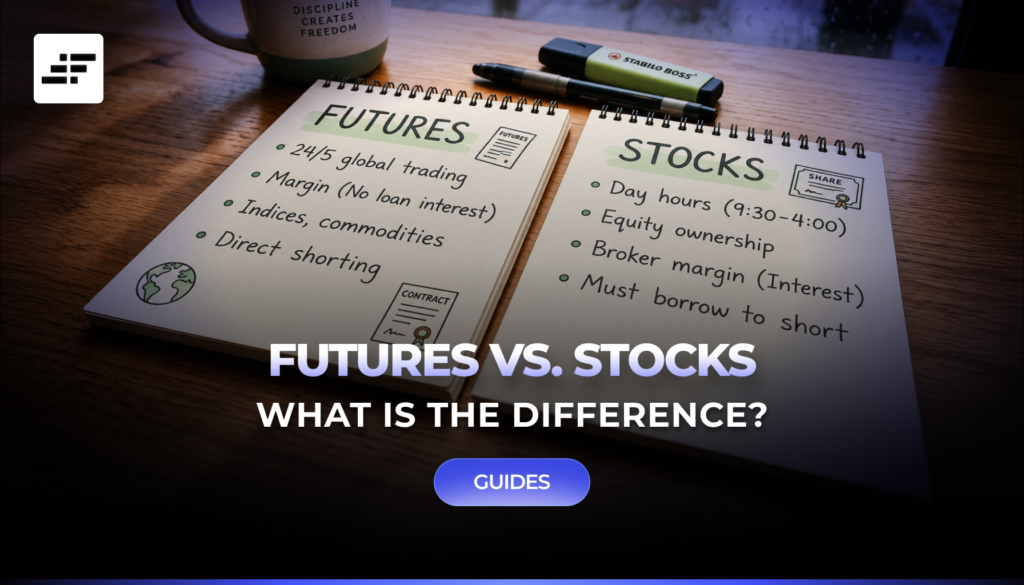
Futures and stocks can look the same on a price chart, but they follow very different rules. Buying a stock gives you part ownership of one company. Trading futures means trading standardized contracts tied to an index, commodity, interest rate, or currency. Those differences change how much money is needed to open a position, when the market is open, how short positions work, and how long a position can last. This guide compares futures vs. stocks across ownership, expiration, trading hours, margin, short selling, and market structure, with worked examples.
Key Terms
| Term | Definition |
|---|---|
| Futures Contract | A standardised agreement to buy or sell an underlying asset at a set price on a future date. |
| Stock | A share representing part ownership of one publicly traded company. |
| Underlying Asset | The index, commodity, interest rate or currency that a futures contract takes its value from. |
| Notional Value | The full value of a futures contract at the current price, such as $50 × the S&P 500 index level for one ES contract. |
| Margin (Performance Bond) | A deposit held to cover potential losses on a futures position. It is not a loan. |
| Mark-to-Market | The daily process of crediting gains and debiting losses on open futures positions, using the exchange’s settlement price. |
Ownership vs Standardised Contracts
When you buy shares of a company, you become a part owner. Shareholders can receive dividends when the company pays them and can usually vote on company matters. Shares have no expiry date, so they can be held for as long as the company stays listed.
A futures contract does not give ownership of anything. It is an agreement to buy or sell an underlying asset, such as the S&P 500 index or gold, at a set price on a future date. The exchange standardises every detail except the price: the contract size, the tick size and the expiration date. Futures holders receive no dividends and have no voting rights.
Contract Expiration and Rollover
Every futures contract has a fixed expiration date. Equity index futures such as ES and NQ expire quarterly, in March, June, September and December, on the third Friday of the contract month at 8:30 a.m. CT. Other markets, such as crude oil, list a contract for each month.
Traders who want to keep a position past expiration close it and open the same position in the next contract month. This is called rolling over. Most index futures settle in cash, so a position still open at expiry is closed at the final settlement price rather than delivered.
Trading Hours
US stock exchanges run regular trading from 9:30 a.m. to 4:00 p.m. ET, Monday to Friday. Pre-market and after-hours trading exist, but fewer orders are usually available outside the regular trading day.
Equity index futures trade on CME Globex from 5:00 p.m. to 4:00 p.m. CT, Sunday to Friday, with a one-hour break each weekday. Prices can therefore move overnight in response to economic releases and news from other time zones.
That schedule describes the exchange, not every account. On Futureify accounts, positions cannot be held overnight, and all open positions are closed automatically at 4:59 p.m. ET (3:59 p.m. CT) each trading day.
Contract Size and Margin
Futures contracts carry a large notional value. One ES contract is worth $50 for every point of the S&P 500 index. With the index at 7,000, one contract has a notional value of 7,000 × $50 = $350,000.
Margin is one of the largest differences between futures vs stocks:
- Stock margin: under the Federal Reserve’s Regulation T, a broker can lend up to 50% of the purchase price of a stock. The borrowed amount is a loan, and brokers charge interest on it. Buying $350,000 of stock on margin requires at least $175,000 of the trader’s own money.
- Futures margin: futures margin, also called a performance bond, is a deposit held to cover potential losses. It is not a loan, so no interest is charged on it. Margin is typically 3% to 12% of the contract’s notional value, which for one ES contract is roughly $10,500 to $42,000.
Smaller margin means more leverage: a small deposit controls a large contract value. Leverage increases losses in the same way as gains. A 1% move in the S&P 500 at 7,000 is 70 points, or $3,500 on one ES contract.
Micro E-mini contracts are one-tenth the size of the matching E-mini, so the same 70-point move is $350 on one MES contract.
Short Selling
A short position gains when price falls. In stocks, opening a short position means borrowing shares through a broker and selling them. The broker must be able to locate shares to borrow, and borrowing them can carry a fee.
In futures, a short position is opened by selling a contract. No shares are borrowed, so there is no locate requirement or borrowing fee, and the process is the same as buying. In both markets, losses on a short position grow as price rises.
Daily Settlement
Futures accounts are marked to market every day. At the end of each trading day, the exchange sets a settlement price, and gains are credited and losses debited from the account. A stock position’s value changes on the screen, but no cash moves until the shares are sold.
Market Structure
In the futures vs stocks comparison, the trading venue also differs. Shares of a single company can trade on several exchanges and other trading venues. A futures contract such as ES trades on one exchange, CME, and CME Clearing acts as the buyer to every seller and the seller to every buyer. Because all trading in the contract is reported in one place, futures volume reflects the full market for that contract.
A single stock can gap sharply after an earnings report or company announcement. Index futures track many companies at once, so one company’s news usually has a smaller effect on the contract. Index futures still react to economic releases, central bank decisions and broader market news.
Futures vs Stocks: Side-by-Side Comparison
| Feature | Futures | Stocks |
|---|---|---|
| What you trade | Standardised contracts | Shares in one company |
| Ownership | None | Part ownership, dividends and voting rights |
| Expiration | Fixed dates, quarterly for index futures | No expiry date |
| Trading hours | 5:00 p.m. to 4:00 p.m. CT, Sunday to Friday | 9:30 a.m. to 4:00 p.m. ET, Monday to Friday |
| Margin | Deposit, typically 3% to 12% of contract value, no interest | Loan of up to 50% under Regulation T, with interest |
| Short selling | Sell a contract, no borrowing | Borrow shares first, possible fees |
| Daily settlement | Yes, marked to market each day | No |
Frequently Asked Questions
Is trading futures riskier than trading stocks?
Futures use more leverage, so the same percentage move produces a larger gain or loss relative to the money deposited. A 1% S&P 500 move at 7,000 is $3,500 on one ES contract, against a margin deposit that can be as little as about $10,500. Micro contracts reduce the dollar value of each move to one-tenth.
Do stock day-trading rules apply to futures?
No. Futures were never subject to the stock market’s pattern day trader rule. For stocks, FINRA has replaced that rule and its $25,000 minimum with new intraday margin standards, effective June 4, 2026, which brokers can phase in until October 20, 2027.
Can futures be held as a long-term investment?
A futures position can be kept for longer than one contract by rolling it into the next contract month before each expiration. Each roll closes one contract and opens another, and futures pay no dividends. On Futureify accounts, positions are closed at the end of each trading day.
What is the difference between ES futures and an S&P 500 ETF?
An S&P 500 exchange-traded fund (ETF) is a share that tracks the index, trades during stock market hours, pays dividends and has no expiry. One ES contract tracks the same index at $50 per point, trades almost 24 hours a day, uses margin and expires quarterly.
Can I trade futures through a simulated prop account?
Yes. Futureify accounts use simulated capital with live market data, and Level 1 data is included free. A futures prop firm evaluation explains how the Flex evaluation and its rules work.
Bottom Line
Futures vs stocks comes down to structure. Stocks give part ownership of one company with no expiry, while futures are standardised contracts with fixed expiration dates, daily settlement and margin deposits that create leverage in both directions. Trading hours, short selling and market structure also differ. See how Futureify works and compare account options on the pricing table.