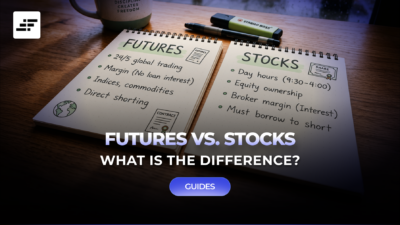
One E-mini S&P 500 contract can control a market value worth hundreds of thousands of dollars, yet opening the position requires only a fraction of that amount. If you know stock trading, you may assume the rest is borrowed from the broker. It is not. Futures margin works differently. This guide explains the main futures margin requirements, including initial, maintenance and day-trade margin, and what happens when an account falls below the required level.
Key Terms
| Term | Definition |
|---|---|
| Performance bond | The formal name CME Group uses for futures margin. It is the minimum amount a customer must deposit with a broker to open or hold a futures position. Both the buyer and the seller of a contract post one. |
| Initial margin | The amount that must be in the account before a position can be opened. |
| Maintenance margin | The minimum amount that must remain in the account while the position is held. It is lower than or equal to initial margin. |
| Day-trade margin | A reduced requirement some brokers apply to positions opened and closed within the same trading day. It is set by the broker, not by the exchange. |
| Margin call | A demand from the broker to add funds or reduce positions after account equity falls below maintenance margin. |
What Futures Margin Really Means
A futures contract is an agreement to buy or sell an asset at a set price on a future date. Opening one does not mean paying its full notional value, which is the total dollar value the contract controls. If a contract represents $100,000 of an index, only a fraction of that amount needs to be in the account to hold it. That fraction is margin.
Margin is not a cost, a down payment or a loan. It does not buy the contract, and it does not limit the loss. It is a good-faith deposit, which CME Group calls a performance bond, held to cover normal price movement in the position.
That distinction matters. A small deposit gives access to a large position, but the profit or loss follows the contract’s full value. This is leverage, and it increases losses as well as gains. Margin shows whether a trade can be opened. The stop-loss distance and the dollar risk show what the trade can lose.
Initial Margin vs Maintenance Margin
Futures margin requirements come in two levels. Exchanges set the minimum for each, and brokers may require more under their own risk policies.
Initial margin is the amount needed to enter
Initial margin is the minimum account balance required to open one contract. As a hypothetical example, a broker might require $1,200 of initial margin to hold one Micro E-mini S&P 500 (MES) contract overnight. Actual requirements change over time, especially when markets become volatile.
Maintenance margin is the amount needed to stay open
Maintenance margin is the minimum the account must keep while the trade is held. If the maintenance level in the example is $1,100 and losses take account equity below it, the broker issues a margin call: a demand to add funds or reduce the position. Under CME Group’s rules, the call must bring the account back up to the initial margin level, not just to maintenance. If neither happens, the broker can close the position.
Margin calls are based on account equity, not on the chart. Equity is the cash balance plus or minus the profit or loss on open trades.
How Futures Margin Works During a Trade
Futures accounts are adjusted as the market moves. At the end of each trading day, the exchange sets a settlement price and every open position is marked to market: profits are credited and losses are debited from the account. Brokers also show open profit and loss in real time during the day.
One MES point is worth $5, and its smallest price move, called a tick, is 0.25 points or $1.25. If one MES contract is bought and the market falls 10 points, the open loss is $50. With five MES contracts, the same move is a $250 loss. With one E-mini S&P 500 (ES) contract, it is a $500 loss.
Day-trade margin can be much lower
Many brokers offer reduced day-trade margin for positions opened and closed within the same trading day. It ties up less capital, but it comes with a condition: the position must be closed before the broker’s cut-off time. If it is still open after that, the full overnight margin applies. Cut-off times vary by broker.
Why Futures Margin Requirements Change
Margin is not fixed. Exchanges and brokers raise requirements when they expect larger price swings, which CME Group reviews as volatility changes. Increases often come around major economic releases, central bank decisions, elections, contract expiry or periods of market stress.
A higher requirement means more capital is needed to hold the same position. If the overnight margin in the earlier example rose from $1,200 to $1,800, an account holding the position close to the old minimum would need more funds or a smaller position.
Futures Margin Is Not the Same as a Risk Limit
Margin is a broker requirement. Risk is the amount a trade can lose before the stop is hit.
Take an account with $3,000 available and a broker that allows several Micro contracts. With a 12-point stop on MES, one contract risks about $60 before commissions and slippage, the difference between the expected exit price and the actual fill. Four contracts risk about $240 on the same trade. Whether that is too large depends on the account size and its daily loss limit, not on the margin available.
A risk-first calculation runs in this order:
- Set the price where the trade idea is proven wrong.
- Measure the distance from entry to that stop in points or ticks.
- Convert that distance into dollars using the contract’s tick value.
- Choose the number of contracts that keeps the loss within the limit.
- Confirm there is enough margin to open and hold that position.
How Margin Differs in a Futures Prop Account
On a Futureify account (formerly FXIFY Futures), trading is simulated and the capital is fictitious, so the trader does not post exchange margin. The limits that apply instead are the account rules:
- Contract limits: for example, 3 Minis or 30 Micros on a $50,000 account.
- Daily loss limit: reaching it stops trading for the rest of that trading day.
- End-of-day trailing drawdown: the floor is calculated from the closed balance at the end of each trading day, so open profit during the day does not move it.
The question on a prop account is whether a normal losing trade fits inside the daily loss limit and the drawdown, not whether the platform allows the contract. Limits for each account size are listed on the How it works page.
Common Futures Margin Misreadings
- Treating margin as the maximum loss. Price can move well beyond the margin posted, so losses can exceed it.
- Holding a day-trade position past the cut-off. Without enough overnight margin, the account can face a margin call or a forced close.
- Treating Micros and E-minis as interchangeable. The same point move is worth ten times more on an E-mini, so the tick value changes the risk.
- Reading margin size as risk level. Real risk depends on price movement, tick value, stop distance and position size, not on how high or low the margin is.
Frequently Asked Questions
Who sets futures margin requirements?
The exchange’s clearing house sets the minimum for each contract. For CME Group products, that is CME Clearing. Brokers can then require more than the exchange minimum under their own risk policies, but not less.
Why is initial margin higher than maintenance margin?
The difference gives the account a buffer before a margin call. For accounts CME Group classes as having a heightened risk profile, initial margin is set at 110% of maintenance margin. For other accounts, the two are equal.
Can you lose more than your futures margin?
Yes. Margin does not cap the loss. A 40-point move against one ES contract is a $2,000 loss, which can be more than the margin posted to open it.
Does a margin call mean the trade is closed automatically?
Not always, but it can be. The broker may ask for more funds or a smaller position first, and it can close positions if account equity keeps falling.
Bottom Line
Futures margin requirements set how much must be in an account to open a position (initial margin) and to keep it open (maintenance margin). Margin is a good-faith deposit, not a cost or a loan, and it does not cap the loss. Position size comes from the stop distance and the dollar risk, with margin checked last. To see the limits that apply on Futureify’s simulated accounts, visit the How it works page.